Swimming the English Channel to Raise Money for ALS
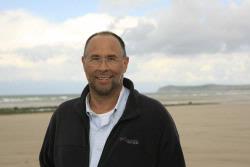
On a Sunday in August 2011, a man hopped into 62 degree water in a speedo, goggles, and swimming cap. Forty-thousand, five-hundred and thirty-eight strokes later, he reached France at 3 a.m.
Doug McConnell shared the story of his swim across the English Channel, which he undertook to raise funds for amyotrophic lateral sclerosis (ALS) research, at the Feinberg Staff Relations Committee’s first Brown Bag Lecture of 2012 on Monday, February 6.
An investment banker from Barrington, Illinois, he took on this challenge to honor his father, who passed away from ALS, also known as Lou Gehrig’s disease, five years ago, and his sister, who has the disease. McConnell raised more than $160,000 in funds for the Les Turner ALS Foundation, which provides funding to support ALS research at Northwestern University Feinberg School of Medicine.
“It was a lesson in teamwork,” said McConnell. “The fact that the team was our family was really special.”
McConnell spent two years preparing for this challenge. His team included his wife Susan, their four kids, and several friends. McConnell is the 48th person older than 50 to complete the swim across the channel. He swam the 32.7 miles in 14 hours and 18 minutes. His time positioned him in 18th place for fastest crossing in his age group.
At age seven, McConnell started swimming with a park district program. He continued to swim throughout high school and at the University of Illinois. In 2005, McConnell started swimming in open water events, and, in 2009, he started training to swim the English Channel.
“The training was daunting. I was in Lake Michigan whenever the water was over 55 degrees,” he said.
While training, McConnell developed a herniated disk in his neck and had spinal surgery at Northwestern Memorial Hospital to replace the injured disk. Six weeks later, he was back in the water.
Arriving in Dover, England, he sat down for a meal of fish and chips before starting his swim at 1 p.m. the next day. A GPS system tracked the crossing so people in the U.S. could follow along, and his wife updated his status on Facebook, including posting videos of his progress.
During the swim, McConnell faced large, choppy waves that disrupted the cadence of his stroke, and avoided the path of jellyfish and the 600 ships that travel the channel daily. Every 30 minutes, he had a feeding stop and a hypothermia check.
McConnell wobbled out of the water onto the beaches of France in the middle of the night. He spent three minutes on shore, and then swam back to the boat, climbed aboard, and headed back to England.
On the way home, McConnell asked his son, “What did you take away from the swim?”
His son responded, “It’s not about the swim. It is about coming up with a goal, figuring out how to put the pieces in place, and knocking it down.”
“What I took away from this is that we are really powerful people and whether it is swimming the English Channel, or finding the cure to ALS, or whatever it is, the power we have is really is beyond measure,” McConnell said.
ALS affects an estimated 350,000 people worldwide, with about 50 percent of those affected dying within three years of its onset.
The Les Turner ALS Foundation Research Laboratory, led by Pembe Hande Ozdinler, PhD, assistant professor at the Ken and Ruth Davee Department of Neurology at Feinberg, opened in October 2008. In people with ALS, motor neurons gradually cease functioning and die. As this happens, the muscle tissues waste away and results in muscle weakness, atrophy, and spasticity.
The lab focuses on the motor neurons in the brain and spinal cord to initiate and control movement. These two motor neuron populations progressively degenerate in ALS patients.
“[Doug’s] life was touched by ALS because he has family members diagnosed with the disease, but he did not take the negative approach. He took something good out of it. He put his courage to work and his strength to work to swim the English Channel,” said Ozdinler.
“What the Les Turner ALS Foundation does is nothing short of miraculous,” said McConnell. “I find the research that they support to be simply inspirational.”
McConnell continues to raise money for ALS research and plans to swim Catalina Channel in Southern California in late July.