What the Experts are Missing: On the Frontier of Data Journalism and Epidemiology
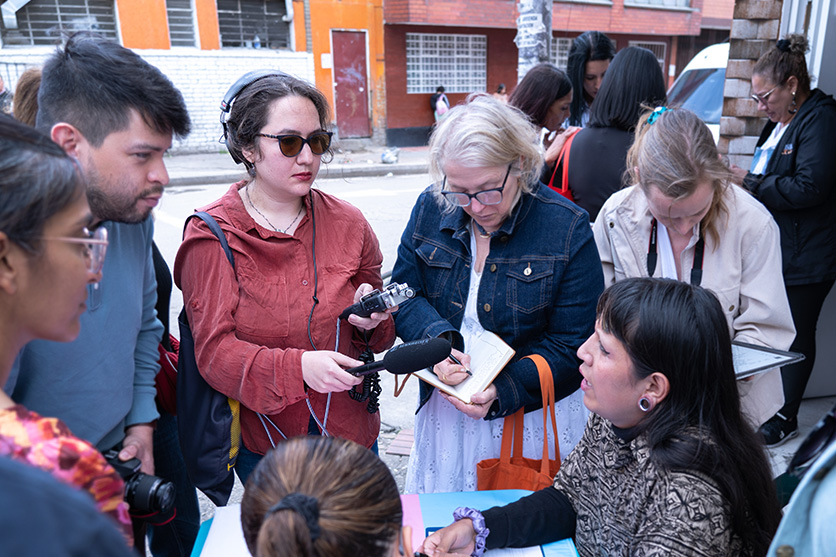
Hannah Harris Green (in red) reporting in the field at Fundación Procrear in Bogota, Colombia. Photo by Andrés Bo.
December 2, 2025
By Andrew Nellis
Given recent announcements by the U.S. Centers for Disease Control and Prevention (CDC), one could be forgiven for thinking that the opioid overdose crisis is well on its way to a resolution. According to the CDC’s latest reports, overdose deaths are decreasing nationwide, but a deeper look into the data reveals disquieting abnormalities: counties that buck the national trend, unexplained spikes in overdose deaths, and gaps in the data itself.
For long-time health reporter Hannah Harris Green, those facts prompted a question: what’s actually happening on the ground?
“No one actually knows for certain,” said Green, who is also enrolled in the Master of Science in Epidemiology program at the Northwestern University Feinberg School of Medicine. “There have been a number of reports about the decline, and people point to things like Naloxone, but we don’t have a clear picture of what’s contributing the most to the decline."
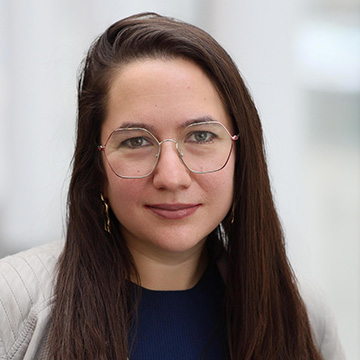
People point to things like Naloxone, but we don’t have a clear picture of what’s contributing the most to the decline.”
Green’s concern? That the oft-hailed solutions to the opioid crisis are masking the main mechanism of overdose deaths, making the country vulnerable and unprepared for a potential resurgence.
To find answers, she partnered with Northwestern University Assistant Professor and data journalist Matt Kiefer. Together, the pair dug into the data, and what they found only added to their unease.
If you want something done right
To understand any public health problem, from diabetes to COVID-19, data is key. Green, who’s been reporting on the nation’s health for 8 years, knows that better than most. Recently, however, she’s grown frustrated with her reliance on outside epidemiologic analyses, which, like the CDC report, can sometimes lead to more questions than answers. Her solution? Analyze the numbers herself.
“I wanted to be able to run my own analysis and look for answers in the raw data,” Green said, speaking about why she joined the MS in Epidemiology program. “Having that ability to combine epidemiology and data analysis with my journalism can help my work have more of an impact on public health.”
But Green wouldn’t do it alone. To help analyze overdose deaths on a national scale, she called up veteran data journalist Matt Kiefer. Together, they got to work
“The best approach, we decided, was to look at the United States as 3,000-plus counties and work backwards from there to determine what significant factors were at play,” Kiefer said.
That was hardly a simple task. As the pair quickly discovered, just sourcing and compiling the data was a months-long process. Even then, they found the government records were lacking in certain states.
To remedy that, Green hunted down and analyzed additional data from other sources, such as Millennium Health, an accredited specialty laboratory that monitors the use of prescription medications and illicit drugs.
Organizing that information, Kiefer said, is often the missing ingredient when translating dense epidemiologic data into actionable insights.
“It may not be the most exciting thing, but data engineering makes it so that journalists, researchers and public health officials have easy access to this information as opposed to a pile of spreadsheets and public records requests,” Kiefer said. “We knit it all together into one simple-to-use database.”
Data engineering makes it so that journalists, researchers and public health officials have easy access to this information.”
Matt Kiefer, assistant professor, Medill School of Journalism, Media, Integrated Marketing Communications.

With that database and her newly-honed epidemiological skills, Green was able to corroborate that a key factor in the decline of overdose deaths wasn’t just the increased use of Naloxone. Rather she found that the amount of fentanyl in the drug supply had a strong correlation to overdose deaths: as the concentration of fentanyl dropped, so did overdose deaths.
When time is of the essence
Analysis in-hand, Green and Kiefer raced to deliver their findings to the people who need it most: the public. On October 17, 2025, The Guardian published their work, showing the trends in national data, highlighting successes in Cook County, Illinois, and detailing the first-hand experiences of people living in Alaska’s overdose epicenter. They also made their data open to the public.
For Green and Kiefer, the project exemplified a dynamic they feel should be more common across higher education: once-siloed fields — such as epidemiology and journalism — joining forces to better inform the public on pressing issues.
In addition to drawing out more nuances from the data, Green’s on-the-ground reporting gave them a window into lived experiences of people most affected by the crisis.
“I have been writing about Naloxone for years,” said Green. “But being in Alaska and talking to people who’ve used or received it multiple times in their recent history completely changed my view.”
Green explained that while Naloxone is an absolute necessity and a literal lifesaver, the medication is incredibly taxing on the person receiving it and the person giving it.
“Of course, I think everyone should have and be trained to use Naloxone,” said Green. “But it’s not a good way to survive.”
Green’s worry is that the overdose-reversing drug will be treated as the ultimate solution rather than a temporary fix. Relying on Naloxone alone, she believes, won't improve the precarious quality of life for people who use it to survive.

For Kiefer, the collaboration is one he hopes can exemplify the value of interdisciplinary journalism and inspire future data journalists. Northwestern’s Medill School of Journalism, Media, Integrated Marketing Communications, is offering expanded coursework in that specialty. The school currently holds beginner, intermediate, and advanced courses on data journalism at undergraduate levels. Medill also offers a graduate concentration in data journalism. Additionally, Northwestern’s Knight Lab continues to develop vital tools for the field, including Census Reporter, which helps journalists gather and analyze census data.
Looking to the future, Green and Kiefer plan to continue their work demystifying public health data in order to better prepare the nation for what’s to come.