Innovative public health and economics research
The Buehler Center for Health Policy and Economics is dedicated to fostering quality research to influence policy and decision-making across public and private sectors.
Our vision is to serve as a leading hub for health policy and economics research, with a commitment to driving innovation, positive change, and improvements to public health on a global scale.
Through collaboration, education, and outreach, we aim to empower leaders with the knowledge and tools necessary to build a healthier, more equitable world for all.
Latest Updates
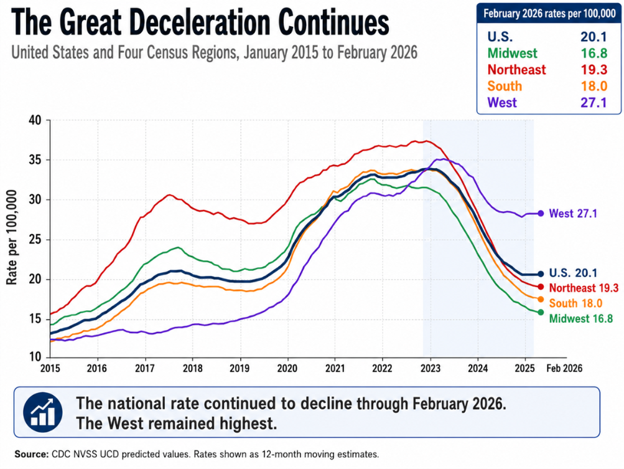
BREAKING NEWS: The Deceleration That Refused to Die
The United States recorded its 33rd consecutive month of declining drug overdose death rates in February 2026 - - the longest sustained downturn since the modern overdose crisis began.

Postmortem Toxicology Positivity for Medications for Opioid Use Disorder in Illinois Unintentional Opioid Overdose Deaths 2019-2024
Currently, most unintentional opioid overdose deaths (OODs) in the United States are attributed to fentanyl. Buprenorphine and methadone reduce mortality associated with opioid use disorder. Despite the protective effects of these medications for opioid use disorder (MOUD), adverse outcomes are possible. The aim of this study is to describe the detection of MOUD in unintentional fentanyl-attributed OODs in Illinois.
Project Spotlight
The OD Pulse
The OD Pulse shows how the overdose crisis is changing by tracking overdose deaths and external factors like time, place and drug type (e.g., opioids, stimulants). The dashboard helps public health agencies, clinicians, policymakers and communities respond more quickly and precisely to a constantly evolving crisis. OD Pulse models map drug overdose death rates to identify emerging inflection points and the underlying dynamics of drug epidemics before they occur.
IVDRS
The Illinois Violent Death Reporting System (IVDRS) links us to the who, what, when, where, how, and why violent deaths occur. IVDRS is a part of The National Violent Death Reporting System (NVDRS) and is the only state-specific surveillance (reporting) system that pools unique data elements from multiple sources into a usable, anonymous database. IVDRS covers all types of violent deaths — including homicides and suicides — in all settings for all age groups.
SUDORS
The Statewide Unintentional Drug Overdose Reporting System (SUDORS) helps us understand emerging trends and factors leading up to the overdose and can be used to develop prevention approaches. SUDORS is a part of Illinois Enhanced State Surveillance of Opioid-Involved Morbidity and Mortality (ESOOS) in partnership with the Illinois Department of Public Health (IDPH) and Ann & Robert H. Lurie Children's Hospital (acting as a bona fide agent of IDPH).
Buehler in the News

Your birth order affects your future, but not for the reason you think
Being born first is better bet in life, the data shows. A landmark 2005 study found that younger siblings fare worse than firstborns on lifetime earnings, educational achievement, mental health and, for women, teen pregnancy. However, firstborns are not special. Parental attention is a finite resource that makes a world of difference.
Historic decline in U.S. overdose deaths threatened by changing street drug supply
Drug overdose deaths continue to drop in the U.S., but experts say new street drugs made from synthetic chemicals are emerging rapidly. NPR's Brian Mann talks with the Buehler Centers Director Lori Post about the changing drug landscape.
Newsletter
Learn the latest about the Buehler Center for Health Policy and Economics through our newsletter. Find information on member awards and successes, new members and upcoming events.
Subscribe Newsletter Archive