‘Hope is Something You Build,’ at the 2026 Community-Engaged Research Conference
July 14, 2026
By Andrew Nellis
Transforming the health of every Chicagoan will require leaders who are determined, forward-thinking, and relentlessly optimistic — and on Wednesday, July 8, more than 200 of those leaders gathered at Northwestern University for the 2026 Community-Engaged Research Conference.
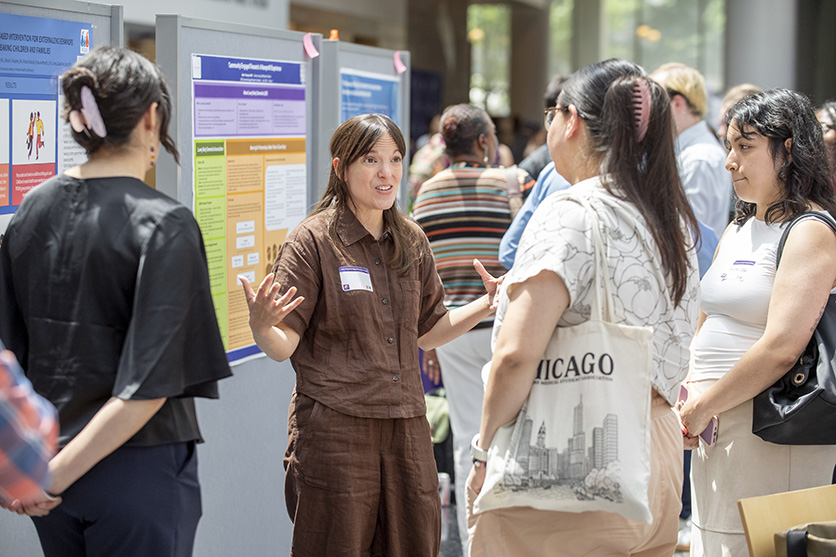
The conference, which was hosted by the Institute for Public Health and Medicine’s Center for Community Health, drew scores of community leaders and their academic partners for a day-long exchange of stories and ideas cultivated in the pursuit of improving the health of all Chicagoans. This year’s theme, ‘From Partnership to Impact: Advancing Community-Driven Solutions Together,’ was front and center throughout the day’s activities, which included multiple panel sessions and over 40 poster presentations.
Sherida Morrison, associate director of the Alliance for Research with Chicagoland Communities (ARCC), welcomed participants with a reflection on the nature of perseverance in challenging times.
“Hope isn’t something we feel, but something we build. We build it through relationships, through trust, and through partnerships,” said Morrison. “We are here today to do exactly that: to speak our truths and create those bonds, and through that, each of us will be fortified with the hope we need to keep building.”
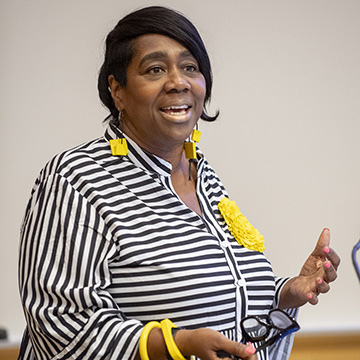
Hope isn’t something we feel, but something we build. We build it through relationships, through trust, and through partnerships”
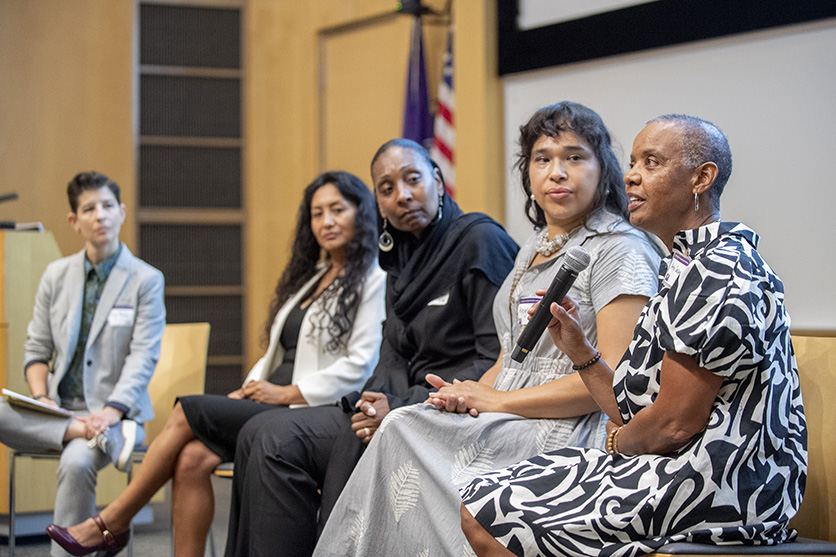
Following a lively and interactive opening talk, the day built with panel featuring the Chicagoland Community Research Fellowship’s inaugural cohort. The fellows, now a year into the program, spoke about their experience and the necessity for dynamic, mutual relationships in research to advance community-driven solutions.
“The greatest discovery happens when universities and communities work side by side as equal partners,” said Edith Freeze, founder and director of the Pachacamak Foundation. “When scientific rigor is combined with lived experiences and community knowledge, research becomes more trusted, more relevant, and more capable of creating lasting change — not just in our communities and neighborhoods, but around the world.”
Several fellows and audience members touched on the concept, with some offering anecdotes about their direct and often personal experience with their areas of focus.
"Our organization is committed to alleviating hunger among those who are living with chronic health conditions, especially cancer,” said Ann W. Jackson, PT, DPT, MPH, founder and executive director of the Center for Food Equity in Medicine. “And when [cancer] came into my own house, it really made a difference with my dad. And then when I had my cancer diagnosis, it turned everything.”
Fellows Maryam K. Muhammad, founder and executive director of the Heal Thy Life Center, and Reyna Ortiz, program director of Taskforce Prevention and Community Services, also spoke on their work and the value of the fellowship.
Building on the idea of bi-directional progress, the day’s second panel featured some of the fellowship’s facilitators and mentors, all of whom touched on the insights they drew from the program.
“Working with and listening to our fellows, there are moments of exchange when they bring concepts to life,” said Cory D Bradley, PhD, MPH, MSW, assistant professor of Medical Social Sciences. “That brilliance to reframe concepts is so important for us investigators and scientists who think we've got the lay of the land. To have folks to come and say, ‘actually, let me put this in real context for you,’ truly expands our knowledge together.”
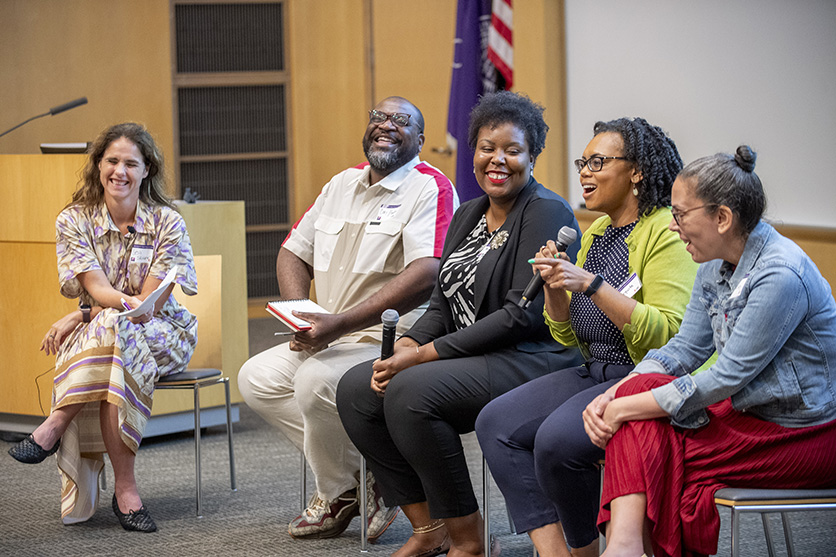
When facilitators were asked what motivated them to support the program and help mentor the fellows, Marquita Lewis, PhD, assistant professor of Medical Social Sciences, underscored the necessity to break down artificial barriers.
“It was an opportunity to take the tools we use in our ivory towers — tools that aren't that hard to grasp but are hugely important for communities — and demystify them so that our communities can advocate on a level field,” Lewis said.
Panelists Ida R Salusky, PhD, MPH, research associate professor of Medical Social Sciences, and Jhmira Alexander, president and executive director of Public Narrative, commented on the resilience of the fellows in the face of federal changes and the importance of sustained institutional investment in this work.
Following lunch and poster presentations, the conference concluded with a final panel session on funding and the evolving landscape of community-engaged research.
“I think there are opportunities,” said Elizabeth B. Lynch, PhD, professor of Family and Preventive Medicine at Rush University Medical Center. “We have a community engagement network called the Alive Faith Network, and that is funded by the Abbot Foundation. That funding has allowed us to build infrastructure and relationships that, over the long term, allows us to do research that's driven by the priorities of the community partners.”
Speaking from a governmental perspective, Inger Burnett-Ziegler, PhD, chief behavioral health officer for the Illinois Department of Human Services, suggested that cultivating relationships in advance can facilitate long-term collaborations.
Alma Rodriguez, senior program officer and director of strategic initiatives for the VNA Foundation, explained the mind-set of those in philanthropic roles.
“Given that our dollars are limited, we see the opportunity to collaborate with other funders and to think about how we could help with capacity building and organizational development,” Rodriguez said.
After the conference, participants spoke about the necessity of the event and the work being done through community-academic partnerships.
“This is really important for community organizations and the research community to actually sit together and talk about the collaborations,” said Candace Henley, MPH, founder of the Blue Hat Foundation, “Being able to listen to the great work that's being done, but also showing what's possible when you have that bidirectional communication.”
“My goal is to enter academic medical research, and I want to make sure I am engaged with the community, and that my research is culturally competent,” said Diana Sanchez, a biological sciences graduate student at Chicago State University. “I haven’t seen a conference like this before, but I have been in the field, and I know how necessary this work is needed.”
A full gallery of photos from the conference can be found here.
The Institute for Public Health and Medicine is a catalyst and nerve center for public health research and education at Northwestern University. Anchored within the Feinberg School of Medicine, the institute’s work is grounded in both clinical and community practice.
The Center for Community Health serves as the main hub at Northwestern for supporting and conducting community-engaged research. The center’s mission is to catalyze, support, and conduct meaningful community and academic engagement across the research spectrum to improve health.