Maggie Caulfield, PhD
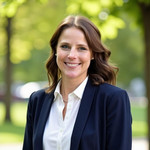
Graduation Year: 2013
Advisor: Brown
Current Position: Director of Research Programs, Parkinson's Foundation
Maggie Caulfield grew up in Fort Wayne, Indiana, and attended undergrad at Saint Mary’s College in Notre Dame, IN. She joined the DGP in 2007, working with Dr. Melissa Brown in the Department of Microbiology-Immunology. After a brief postdoc at the Mayo Clinic, Maggie joined the faculty of Calvin College as an Assistant Professor of Biology. She later transitioned to Assistant Professor of Translational Neuroscience at Michigan State University. In 2024, Maggie took her career in a new direction as the Director of Research Programs at the Parkinson’s Foundation.
What made you want to go to graduate school?
I wanted to be a college professor at a small liberal arts college, and I loved my first research experience at an REU (a summer Research Experience for Undergraduates) at Notre Dame. I eventually did reach this goal and was a tenure track faculty member for 3 years before COVID happened, and then I reassessed my career.
What brought you to Northwestern and the IGP/DGP?
We visited Northwestern during my REU summer fellowship. Also, the location in downtown Chicago was exciting and only a few hours from home.
What did you study in graduate school?
Immunology, T cells and mast cells in models of multiple sclerosis
What did you study in your postdoc?
Neuroscience, in a Neurology lab where I focused on the cell biology of multiple sclerosis and neuromyelitis optica
How about as a faculty member? Did your interests change over time?
My current field is Parkinson's disease research, with a focus on pre-clinical research and programs to help expedite the development of new therapies for PD. When I decided to get back into research after my time as a faculty at a small liberal arts school, I changed my focus from multiple sclerosis to Parkinson's disease. This was not something I had previously anticipated, but it was necessary based on the positions that were available at the time. Turned out that this change allowed me to get my current position, which is a great fit.
What drove your decision to transition from faculty to a non-profit position?
After being in academia at different stages and institutions for over 15 years, I had a strong desire to be more closely connected to the community that my research was ultimately serving. I was ready to be out of the lab and working to improve the lives of people living with Parkinson's disease every day. Additionally, I was looking for fully remote positions to allow more availability for my family and decrease the juggle of in-person work and raising kids.
Can you tell me a little bit more about your day-to-day work in your current position?
As the Director of Research Programs for the Parkinson's Foundation, I have the opportunity to work in many different areas with teams across the foundation.
Some of my roles and responsibilities include:
- training new staff and field teams on the research programs at the Foundation
- working as a member of our grants team to support research grants or early career scientist and innovative projects
- public speaking at Foundation education events all over the US
- managing industry partner relationships/collaborations around our research efforts
- acting as industry lead in our pilot program PD Trial Navigator which works to connect people living with Parkinson's to trials for which they may be eligible
- attending national and international scientific conferences to stay apprised of the latest research
- collaborating with Parkinson's UK on a joint venture philanthropy program called Parkinson's Research Ventures (formerly Virtual Biotech)
- meet with donors/potential donors about current research programs at the Foundation
How did Northwestern prepare you for your current career?
My training at Northwestern provided ample opportunities to present my research and write both manuscripts and grant applications. These were all very important as my career has progressed. Whether I was in the lab, teaching and doing research with undergrads, or working at the Parkinson's Foundation, these skills have provided the basis for my advancement.
What is the most rewarding part of your job?
The most rewarding part of my job is when I get to go to community events and speak about the research at the foundation. I am able to interact directly with people living with Parkinson's, answer at least some of their questions, and hopefully provide a little excitement about what is in the pipeline for PD.
What is the most challenging part of your job?
The most challenging part of my job is not being able to point community members to a disease modifying therapy or cure for PD. Another ongoing challenge is to "translate" sophisticated biological and clinical information for lay audiences.
What advice would you give to current students interested in pursuing careers in academics?
I think it is an exciting time to be in research with the boom in technology and general appreciation of the value of collaboration. I would advise students to worry less about the specific, narrow field they want to study and rather to surround themselves with good mentors, coworkers and collaborators. You end up spending so much time in this group that it is crucial to have a stable support structure. Also, take all the chances you can to do presentations and write about your science. It may be painful at the time, but it will pay you back regardless of what you end up doing next.
For students looking for a career in a non-profit environment, would your advice be any different from those looking for careers in academics? Any additional skills they should build or activities they should pursue?
In my experience it has been useful to have a wide variety of previous roles both in academia (lab work, teaching, volunteering, etc.). This has allowed me to accrue skills in many different areas, both "hard and soft" skills. This is so important for foundation work because on a single day I could go from speaking to a member of the PD community to a spouse of someone living with PD, to an academic researcher, to a colleague on the communications team, to an industry partner who is running a clinical trial. Having a wide breadth of skills and the ability to tailor your interactions appropriately is key to a position like mine. So I would encourage students to take advantage of opportunities outside the lab to be able to develop some of these other skill sets, to take on extra writing or speaking engagements, teaching, curriculum development for different grade levels, volunteer, work or speak in the lay community, etc etc. There is a big world out there and the bench is just one aspect of it!
Any final advice for students?
When I was in graduate school and feeling overwhelmed, my Dad said "If it was easy, then everyone would do it." That was all it took for me to realize I was meant to be challenged and helped me rise to that challenge.