
FEBRUARY 2026 NEWSLETTER
The newsletter of the Feinberg School of Medicine Research Office
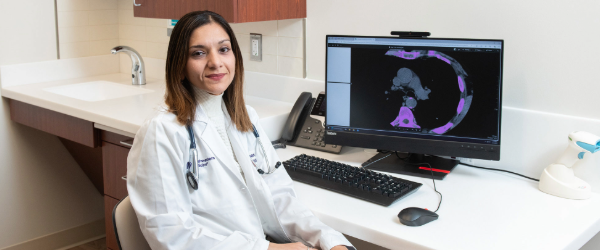 |
Advancing Preventive Care and Cardiovascular Risk Prediction Through Online Tools |
|
Recently named to the Time100 Health 2026 list, Sadiya Khan, MD, is establishing herself as a leader in preventive cardiology and calling for younger people to think about their heart health earlier in life. The Magerstadt Professor of Cardiovascular Epidemiology, Khan studies the epidemiology of risk for cardiovascular disease (CVD). Using population-based cohorts and large electronic health record data analyses, she performs epidemiologic and mechanistic studies to enhance risk prediction and identify novel therapeutic targets for the prevention and treatment of cardiovascular disease. |
 |
New Institute Envisions Future Where Our Brains Last as Long as Our Bodies |
|
Northwestern University has launched the Simpson Querrey Brain Health Institute (SQ-Brain), made possible by nearly $25 million in philanthropic funding from university trustee Kimberly K. Querrey (’22, ’23 P). Farzaneh Sorond, MD, PhD, vice dean for Faculty Affairs and the Dean Richard H. Young and Ellen Stearns Young Professor in the Ken and Ruth Davee Department of Neurology, will lead the institute as the founding director of SQ-Brain. |
 |
New Computational Biology Track Added to PhD Graduate Program |
| A new PhD track is being added to the Walter S. and Lucienne Driskill Graduate Program in Life Sciences (DGP) for the 2026 application cycle to enhance student learning and build community around computational biology and bioinformatics at Feinberg. |
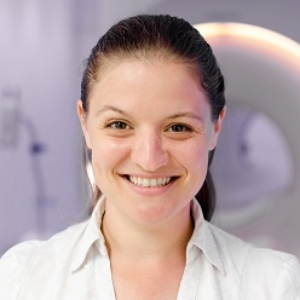
Faculty ProfileDeveloping Advanced MRI Methods to Better Understand the BrainMolly Bright, DPhil, is an assistant professor of Physical Therapy and Human Movement Sciences and of Biomedical Engineering in the McCormick School of Engineering. Her research focuses on developing functional MRI (fMRI) techniques to assess the function and interaction of neural activity and vascular physiology throughout the central nervous system. |
|
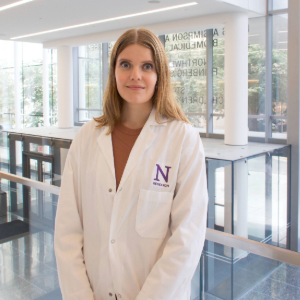
Post-Doc ProfileStudying Interneurons and Retinal Cells to Understand VisionJulia Fadjukov, PhD, is a post-doctoral fellow in the laboratory of Gregory W. Schwartz, PhD, the Derrick T. Vail Professor of Ophthalmology. In the lab, her research spans amacrine cells and retinal ganglion cells in an effort to better understand vision in mice. |
|
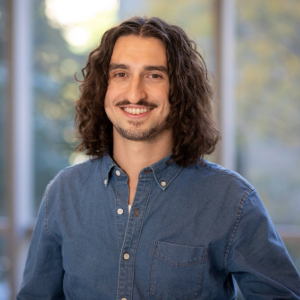
Student ProfileUsing Brain Recordings to Investigate the Parietal CortexJoseph Kelly is a PhD student studying clinical neuropsychology. In the laboratory of Jason Hsieh, PhD, assistant professor of Neurological Surgery, he studies the electrophysiology of memory formation in the developing brain using direct brain recordings through intracranial electroencephalogram (EEG). |
|
Campus Events |
||||||||
|
Research in the NewsChicago Sun-Times, January 16 Crain's Chicago Business, January 16 CBS News, January 14 |
NUCATS CornerNUCATS Launches Revised Service Request FormTo enhance accessibility to the many research resources available to you at NUCATS the Institute has launched a revised Service Request Form for various request needs including NUCATS membership, clinical research support, education and career development opportunities, grant development support and more. The revised Service Request Form can also be found on the NUCATS website under “Need Help?" |

|
Breakthroughs PodcastNew Paths for Diagnosing and Treating Lyme Disease with Brandon Jutras, PhDTwo pivotal studies on Lyme disease from the lab of Brandon Jutras, PhD, provide important insights into what may cause persistent Lyme disease symptoms in a subset of patients. This research points to some promising new directions for both diagnosis and therapeutic intervention. |

|
New FacultyWenna Xi, PhD, joined the Division of Biostatistics and Informatics as assistant professor of Preventive Medicine in June 2025. Previously, she was a postdoctoral fellow at Weill Cornell. She earned her PhD from The Ohio State University, and her methodological research focuses on statistical challenges in the design and analysis of large-scale health data, including electronic health records, insurance claims and complex survey data. Her applied research interests include children and youth mental health, health disparities, health services, neighborhood effects and social determinants of health. She is affiliated with the Northwestern University Data Analysis and Coordinating Center (NUDACC). |

|
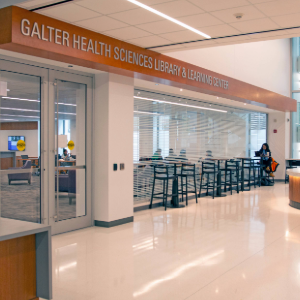
Galter LibraryFeinberg’s Researchers Named to Highly Cited Researchers List for 2025Across Northwestern University, 36 researchers were recognized on the 2025 list. Northwestern ranked 34th among the top 52 global institutions that serve as primary affiliations to Highly Cited Researchers, highlighting the university’s broad scholarly influence across disciplines. |
|
High Impact ResearchMcDermott MM. Peripheral Artery Disease in the Legs. The New England Journal of Medicine. Jan 2026; 394(5):486-496. Muenzer J, Burton BK, Harmatz P, Rajan DS, Jones SA, van den Hout JMP, Mitchell JJ, Bhalla A, Engmann NJ, Zubizarreta I, Dong W, Model F, Watts RJ, Troyer MD, Chin PS, Ho C. An Intravenous Brain-Penetrant Enzyme Therapy for Mucopolysaccharidosis II. The New England Journal of Medicine. Jan 2026; 394(1):39-50. Ng B, Harris AC, Abdossamadi S, Aubert G, Bajwa R, Bhatia M, Bittencourt H, Buxbaum NP, Caywood EH, Chaudhury S, Chewning JH, Choi SW, Chopek A, Chu J, Coulter D, Gadalla SM, Hogg RT, Jacobsohn DA, Johnson AK, Joyce M, Kasow KA, Kent M, Kitko CL, Lau D, Lawitschka A, Lewis VA, Li AM, McLaughlin L, Mitchell D, Nemecek ER, Parthasarathy V, Pawlowska AB, Pirsl F, Pulsipher MA, Qayed M, Rozmus J, Savaşan S, Schechter T, Shenoy S, Suleimenova A, Zheng DJ, Ostroumov E, Gilman A, Klein Geltink RI, Wolff D, Cuvelier GDE, Schultz KR. Distinct biological subtypes of chronic GVHD after pediatric hematopoietic cell transplantation. Blood. Jan 2026; 147(3):241-253. Niederkorn M, Bezavada L, Cotton A, Palmer LE, Konada L, Hall T, Pagala VR, Zhai J, Yuan ZF, Fu Y, Steele JA, Narina S, Schild A, Wu C, Aminov S, Schieber M, McGovern E, Taylor AB, Gurbuxani S, Xu P, Ji P, Janke LJ, High AA, Kang G, Pruett-Miller SM, Weiss M, Verma A, Rampal RK, Crispino JD. FBXO11 suppression rewires an NPM1-centered interactome influencing the progression of myelodysplastic syndrome. The Journal of Clinical Investigation. Jan 2026; 136(2). |
Featured CoreBehavioral Phenotyping CoreThe mission of the Northwestern University Behavioral Phenotyping Core is to make available to funded research projects a facility to determine the behavioral effects of genetic manipulations, potential pharmaceuticals, aging, and other manipulations upon normal behavior, and the learning and memory capacities of rodents used as model systems. The BPC will also work with PIs to gather pilot data for new applications. What is OfferedConsultations
|
NIH Policy Notices
|
Funding OpportunitiesRigor and Reproducibility for Biomarkers in Type 1 Diabetes Clinical Research
In Vivo High-Resolution Imaging for Inner Ear Visualization (R01 Clinical Trial optional)
Schizophrenia and related disorders during mid- to late-life (R01 Clinical Trial Optional)
|
Thank You For ReadingWe welcome your feedback. Please share it with us via email. |
|
|
