
February 2026 Newsletter
February 2026 Newsletter
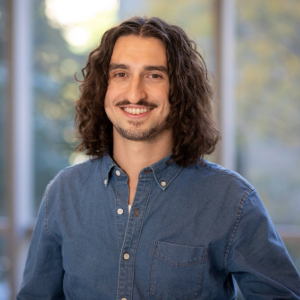
Student Profile
Joseph Kelly is a PhD student studying clinical neuropsychology. In the laboratory of Jason Hsieh, PhD, assistant professor of Neurological Surgery, he studies the electrophysiology of memory formation in the developing brain using direct brain recordings through intracranial electroencephalogram (EEG).
Where is your hometown?
Riverside, Illinois. It is a lovely little town in the southwest suburbs of Chicago.
What sparked your interest in science or medicine?
Philosophy and family. Back in undergrad, I majored in what’s called a Great Books program, and I had the opportunity to read a lot of old books. Kant, Plato, Augustine—it’s astonishing what people discovered about the mind by just sitting in a room and pondering things. Kant’s comments on epistemology and sense perception were especially impactful for me. These days I study the mind through neuroimaging methods rather than philosophical analysis, but the overarching questions are similar. How do we think? Perceive? Remember? That said, I wouldn’t have pursued philosophy or neuroscience in the first place without the influence of my dad. He’s a neurologist who has always found the time to learn about bigger questions, and he instilled that curiosity in me.
What are your research interests?
I’m interested in how memory works and how it goes awry with disease or injury. In our lab, we use a method called intracranial EEG, in which we directly record the brain’s electrical activity from surgically implanted electrodes in neurosurgical patients. (The implantation is part of their clinical care.) Put simply, this method is like putting a tiny microphone next to a few hundred thousand neurons and listening to their chatter as the patient performs an experimental task —e.g., remembering a face, a place or their graduation day. With this method, we can uncover the brain regions and electrophysiological mechanisms that support memory. Beyond these questions of basic science, I’m also interested in doing clinical research on the cognitive outcomes of neurosurgical treatments.
What are you currently working on?
I’m currently investigating how electrical activity in the parietal lobes supports recognition memory across childhood and adolescence. A lot of cognitive neuroscience to date has focused on the role of the medial temporal and frontal lobes in recognition memory, but we understand much less about how the parietal cortex contributes, especially in the developing brain. The study I’m working on will be the first intracranial EEG study to investigate parietal cortex and memory in kids and adolescents.
Please tell us about a defining moment in your education at Feinberg thus far.
As a clinical neuropsychology trainee, I had the opportunity to see a tumor patient for a pre-surgical cognitive evaluation and then observe that same patient’s awake craniotomy days later. Seeing the neuropsychologist and neurosurgeon work together in the operating room was a defining moment (brain surgery is amazing), and I want to pursue those kinds of clinical opportunities in my own career.
What do you hope to do with your degree?
I want to be a clinical neuropsychologist who sees patients, does research and teaches students at an academic medical center. I like helping people, I like learning and I like teaching— doing all three would be ideal for me.
