
February 2026 Newsletter
February 2026 Newsletter
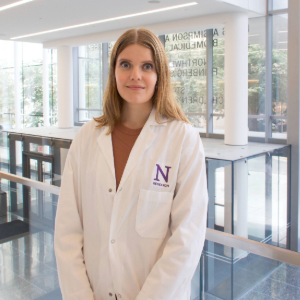
Post-Doc Profile
Julia Fadjukov, PhD, is a post-doctoral fellow in the laboratory of Gregory W. Schwartz, PhD, the Derrick T. Vail Professor of Ophthalmology. In the lab, her research spans amacrine cells and retinal ganglion cells in an effort to better understand vision in mice.
Where is your hometown?
I was born and raised in Turku, a historic coastal town in the south of Finland located about two hours from the capital Helsinki. In June 2023, I moved to Chicago and now live in Edgewater. I’ve grown fond of the city’s vibrant neighborhoods, abundant parks and striking lakefront — it’s been a wonderful place to call home during this stage of my career.
What led you to Northwestern?
My connection to Northwestern began long before I joined as a postdoctoral scholar. In 2015, just as I was starting my PhD, I met my current advisor, Greg Schwartz, PhD, at a European Retina Conference in Brighton, UK. I was deeply fascinated by his group’s pioneering work on classifying retinal ganglion cells and his expertise in electrophysiological techniques. Years later, when my graduate institution offered funding for short-term research visits abroad, I reached out to Schwartz to see if I could spend a summer in his lab. He graciously welcomed me, and in 2018 I spent an inspiring summer in Chicago as a visiting scholar. I fell in love with both the city and the lab’s collaborative, intellectually stimulating environment. When the opportunity arose to join Northwestern as a postdoc, I knew it was the perfect place to continue my academic journey. Working here has pushed me to grow as a scientist, especially in computational neuroscience, and I have also had the chance to contribute to teaching through the NUIN program.
What are you currently working on?
My research spans two main projects. The first aims to achieve a unified classification of displaced amacrine cells in the mouse retina by combining electrophysiology, confocal imaging and transcriptomics — an effort to integrate functional responses with structure and gene expression. In my second project, I focus on retinal ganglion cells, exploring how their intrinsic properties influence spatial integration, which is critical for understanding how visual information is encoded early in the visual system. I am also part of the international Eyewire II electron microscopy consortium, a collaborative effort to map and characterize the intricate wiring of the mouse retina at ultrastructural resolution. This consortium brings together neurobiologists, computer scientists and citizen scientists to build one of the most detailed retinal datasets to date, advancing our understanding of retinal circuits and connectomics.
How does your work support the research enterprise at Feinberg?
Our research exemplifies multidisciplinary collaboration. The lab’s work involves technically demanding approaches — from electrophysiology to high-resolution imaging and computational analysis — and we are fortunate to partner with multiple research cores and facilities at Northwestern. These collaborations not only fuel our projects but also contribute to the broader research ecosystem at Feinberg by fostering shared expertise and innovation.
