Student Research
2026 Synthesis Day Research
Read more on a selection of student research posters presented at the 2025 Kaleckas Lecture and Synthesis Day.
Clinical Instructors’ Use of AI to Teach, Mentor, and Lead Doctor of Physical Therapy Students
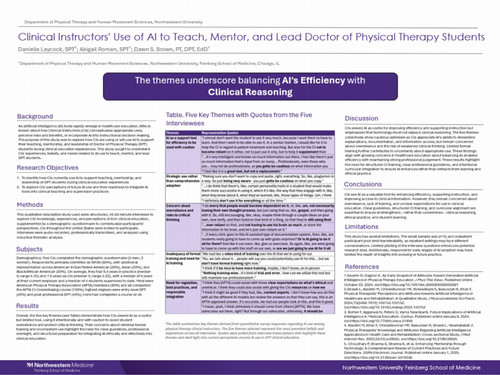
This study explored how Clinical Instructors (CIs) use or may use artificial intelligence (AI) to support teaching, mentorship, and leadership of Doctor of Physical Therapy (DPT) students during clinical education. As AI tools rapidly emerge in healthcare and education, little is known about how CIs conceptualize appropriate uses, perceive risks and benefits, or incorporate AI into instructional decision making. This study
examined CIs’ experiences, beliefs, and needs related to AI use in clinical education.
iPad App-Based Eye Tracking Demonstrates Excellent Concurrent Validity in Saccadic Eye Movements with EyeLink®, a Clinical Grade Eye Tracker
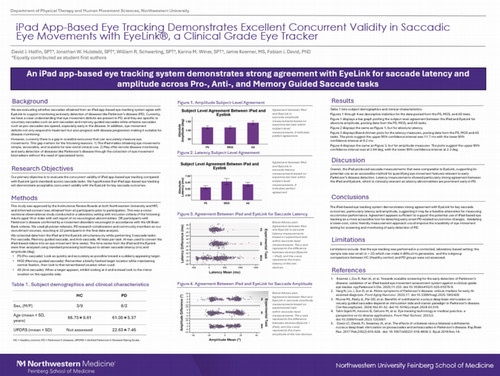
Early detection and disease monitoring in Parkinson’s disease (PD) is challenging. Diagnosis occurs well after the neurodegenerative process starts and when motor symptoms are well established and disease monitoring often relies on subjective clinical assessments.Saccadic eye movements can be used as biomarkers for both early detection and disease monitoring. Yet the current clinical-grade eye-tracking devices are expensive,
require specialized personnel, and not easily scalable. There is a need for low-cost, simple, and scalable tools. One option is consumer-grade devices like the iPad, which can be used for tracking eye movements. However, the concurrent validity of the iPad remains to be determined. Here we present concurrent validity of the iPad with the Eyelink®, a clinical-grade gold-standard eye tracker. This was a cross-sectional observational study done in a laboratory based setting with 22 adult participants (Healthy controls: n = 12, Parkinson’s disease: n = 10). Data from the iPad and the EyeLink were obtained simultaneously. AI was used to convert eye movement videos from the iPad to an eye movement time series. This time series was subject to standard processing techniques to obtain saccade metrics of latency (ms) and amplitude (deg) while performing three saccade tasks: Anti-saccade, Pro- saccade, Memory-guided saccade, 40 trials per task.
Exploring the Intersection Between Adults with Spastic Cerebral Palsy and Symptoms of Mental Health
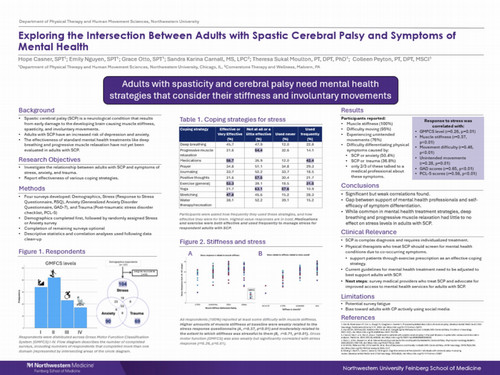
Spastic cerebral palsy (SCP) is a neurological condition resulting from early damage to the developing brain causing muscle stilness, spasticity, and involuntary movements. In addition to physical symptoms, adults with SCP have an increased risk of depression and anxiety. Standard mental health treatment includes strategies like deep breathing and progressive muscle relaxation; however, their electiveness has not been evaluated in adults with SCP. The purpose of this study is to investigate the relationship between adults with SCP and symptoms of stress, anxiety, and trauma and reports of elective and inelective coping strategies.
Evaluating Acromiohumeral Distance and Its Association with Shoulder Function in Individuals with Hemiparetic Stroke
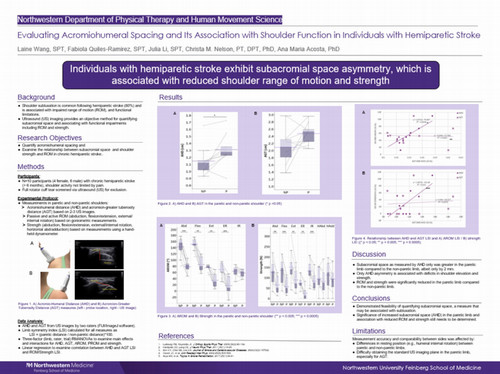
Shoulder subluxation is a common complication following hemiparetic stroke and is associated with impaired range of motion (ROM), and functional limitations. 34 Ultrasound imaging provides an objective method for quantifying subacromial space by measuring the acromiohumeral distance (AHD) and the acromion-greater tuberosity distance (AGT).67 The purpose of this study was to examine the relationship between subacromial space asynmmetry and shoulder ROM and strength in individuals with chronic stroke.
Widespread Pain In the Emergency Department: A Marker for More Than Musculoskeletal Low Back Pain
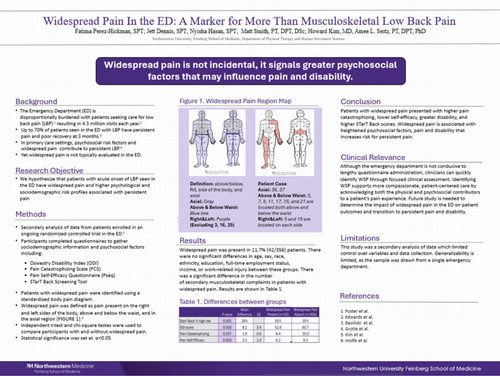
The Emergency Department (ED) is disproportionally burdened with patients seeking care for low back pain (LBP) resulting in 4.3 million visits each year (1,2). Up to 70% of these patients have persistent pain and poor recovery at 3 months (3). In primary care settings, psychosocial risk factors and widespread pain have been found to contribute to persistent LBP (4). Yet, widespread pain is not routinely evaluated in the ED. We hypothesize that patients with acute onset of LBP seen in the ED have widespread pain and higher psychological and sociodemographic risk profiles associated with persistent pain.
Redefining Cardiorespiratory Fitness Standards: Addressing Representation of Social Determinants of Health in Cardiopulmonary Exercise Testing
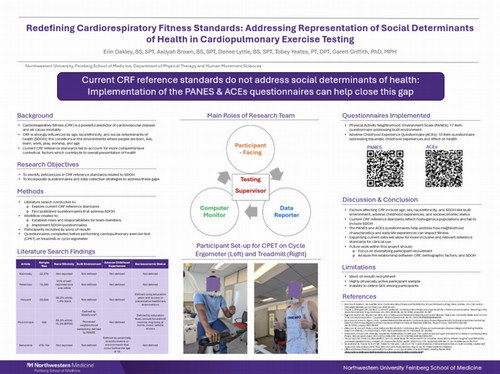
Cardiorespiratory fitness (CRF) is a powerful predictor of cardiovascular disease and all-cause mortality.1 CRF is a modifiable risk factor that is strongly influenced by age, race, ethnicity, and social determinants of health (SDOH), including adverse childhood events, built environment, and socioeconomic status (SES).2,3 Currently, when CRF is evaluated, it is compared against age- and sex-based reference standards, which fail to account for more comprehensive contextual factors that contribute to an individual’s overall presentation of health.