
October 2026 Newsletter
October 2026 Newsletter
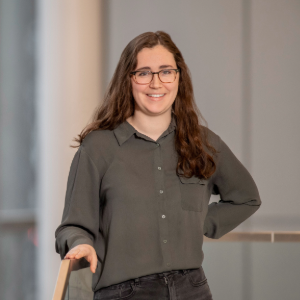
Student Profile
Anneke Thorne is a PhD candidate in the Driskill Graduate Program in Life Sciences. In the laboratory of Joseph Bass, MD, PhD, Thorne’s work centers on how specialized fat cells burn energy to generate heat, a process known as adipose tissue thermogenesis. Her research examines how circadian rhythms regulate this process and how meal timing interacts with these biological systems.
Where is your hometown?
I was primarily raised in Iowa City, Iowa, a university town that is home to the University of Iowa and was the first city in North America designated as a UNESCO City of Literature. I also spent a year living in Utrecht, the Netherlands, a vibrant city known for its cycling culture and the world's largest bicycle parking garage.
What sparked your interest in science or medicine?
My high school freshman biology teacher, Jenifer Secrist, had an infectious enthusiasm for biology. A year later, when my parents told me I needed to find a summer job, I reached out to Julien Sebag, PhD, who was launching a new research lab at the University of Iowa studying how G-protein coupled receptors regulate hunger sensing and metabolic health. I joined the lab as one of its earliest members and ultimately stayed for three summers. From my very first summer in the lab, I was hooked and knew I wanted to pursue a career in biology. I remain deeply grateful to Julien for taking a chance on a high school student and showing me how exciting biomedical research could be.
What are your research interests?
I never fell out of love with studying metabolism. I am fascinated by the many ways organisms have evolved to regulate energy intake and expenditure, and by how those systems can backfire with modern environments where calorie-dense food is readily available. In the Bass Lab, I study how the time of day influences the way the body processes and metabolizes food.
What are you currently working on?
I study how specialized brown and beige fat cells burn energy to generate heat, a process known as adipose tissue thermogenesis. My research examines how circadian rhythms regulate this process and how meal timing interacts with these biological systems. Light synchronizes the body's central clock, which then communicates timing information to tissues throughout the body, including fat, preparing them to process nutrients during the normal active period of the day (or night, for mice). When food intake is consistently out of sync with these biological rhythms, thermogenesis becomes impaired, and energy expenditure declines. I am working to understand the biological mechanisms underlying this effect, and whether they can be targeted therapeutically. I recently published a first-author paper in PNAS titled "An RNA Thermogenic Therapy to Preserve Lean Mass and Enhance Metabolic Health During GLP-1 Weight Loss." This work supports targeting adipose thermogenesis as a complementary therapeutic strategy with GLP-1s to achieve metabolically healthier obesity treatment.
Please tell us about a defining moment in your education at Feinberg thus far.
Receiving the email that my first-author manuscript had been accepted for publication was a defining moment for me. I had been working toward that goal for more than a decade. It also made me reflect on how much I've learned and how many mentors and collaborators have helped me along the way. I am grateful to be part of a community at Feinberg that continually challenges and inspires me.
What do you hope to do with your degree?
I look forward to pursuing a postdoctoral fellowship to continue my training. I hope to continue studying adipose tissue metabolism and ultimately to lead my own independent research focused on metabolic health and disease.
