
November 2026 Newsletter
November 2026 Newsletter
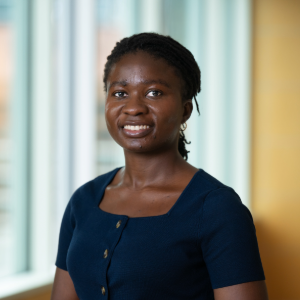
Student Profile
Mercy Berchie is a PhD student in the Health Sciences Integrated Program (HSIP) studying health and biomedical informatics.
Berchie received her Doctor of Optometry (DO) degree from the University of Cape Coast, Ghana. Prior to joining HSIP, she worked as an intern optometrist and a research and teaching assistant in the Department of Optometry and Vision Science at the University of Cape Coast, Ghana. Her research interests focus on using informatics tools and methodologies to improve health and healthcare, particularly in ophthalmic diseases.
Where is your hometown?
My hometown is Akyem Kwabeng, a small town in the Eastern Region of Ghana.
What sparked your interest in science or medicine?
My interest in science developed gradually, beginning with an interest in human behavior, patterns and how they shape society. Over time, I became interested in how these patterns influence health and access to healthcare. I pursued a DO degree out of a desire to help people see better and access quality eye care services. Through my training, I discovered an interest in data analytics and the potential to uncover patterns in healthcare data that could shape healthcare delivery and improve health outcomes.
What are your research interests?
I am broadly interested in translational science and biomarker development. I study how measurable indicators of health and disease can be used to improve disease prediction, diagnosis, and management for personalized healthcare delivery.
What are you currently working on?
I am currently working on my dissertation in which I examine how retinal microvasculature can improve cardiovascular health prediction, both in individuals and across communities.
At the clinical level, I investigate whether retinal biomarkers can improve cardiovascular risk assessment and help guide more personalized prevention. At the community level, I study how environmental and socioeconomic conditions relate to retinal microvascular health across Chicago neighborhoods. My goal is to develop approaches that use retinal imaging to assess community cardiovascular health and better understand how neighborhood conditions shape health.
Please tell us about a defining moment in your education at Feinberg thus far.
My education at Feinberg has been shaped by the cumulative impact of mentorship and interdisciplinary learning. Learning from people with different areas of expertise has deepened my scientific curiosity, broadened how I approach research questions, and helped me become a more adaptable scientist. I am especially grateful for the community of mentors who continue to support and challenge me as I grow.
What do you hope to do with your degree?
I hope to build a career in biomarker development, particularly within drug development and clinical trials. I am interested in using biomarkers to better understand differences in treatment response and help guide more personalized care. In the long-term, I would like to help shape research strategy by identifying promising scientific opportunities and developing plans that translate discoveries into meaningful improvements in patient care and health equity.
