
April 2026 Newsletter
April 2026 Newsletter
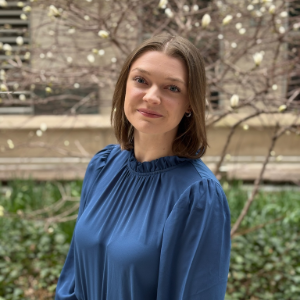
Student Profile
Katie Cohen is a PhD candidate in the Health Sciences Integrated PhD Program (HSIP) at Feinberg. Her research interests focus on improving youth mental health by creating and implementing innovative, accessible, evidence-based solutions.
Where is your hometown?
North Augusta, South Carolina
What sparked your interest in science or medicine?
When I was growing up, I didn’t realize what mental health conditions were, let alone that there were treatments for those conditions. When I started studying psychology at my undergraduate institution, it opened up a new world. Just as I was learning what we know about mental health, I was also learning how much we don’t know, and how we need scientists to explore the unknown. As a kid, I thought that being a scientist meant exclusively working with microscopes and test tubes, but when I learned that you could be a scientist who studies how to treat mental health conditions, I knew I’d found my calling.
What are your research interests?
My work bridges intervention and implementation science methods to address rising youth mental health concerns through a public mental health perspective. My research focuses on digital, self-administered, free-to-use single-session interventions (SSIs) that can reduce mental health distress among youth and increase uptake of existing mental health services. My recent work has focused on schools as a promising setting for delivering these interventions to youth at the population level.
What are you currently working on?
I’m currently working on my dissertation, which leverages implementation science frameworks, qualitative methods and community-engaged approaches to understand how SSIs can be sustainably implemented in schools.
Please tell us about a defining moment in your education at Feinberg thus far.
I took a class on community-engaged research that transformed how I see the role of researchers. Since taking that class, I have shifted my methods to actively engage community members as equal partners in the scientific process rather than viewing them as “participants" to study.
What do you hope to do with your degree?
I hope to become a professor so that I may continue my research while also teaching and mentoring the next generation of scientists. There are still so many youth out there who are having the same experiences I had growing up, not knowing enough about mental health and not realizing that you can be a scientist who studies mental health. I hope my research, teaching and mentoring can provide them with what I wish I'd received earlier.
